Competitive Landscape
Unizap (then operating under its original name) competed for merchant and buyer attention in a category where first impressions form fast — a name that's hard to pronounce or spell creates friction at every single touchpoint a competitor with an easier name doesn't have to overcome. That friction wasn't visible in traditional competitive analysis; it only showed up in call transcripts, support tickets, and the moment before someone introduced the company to their boss.
Customer Insight
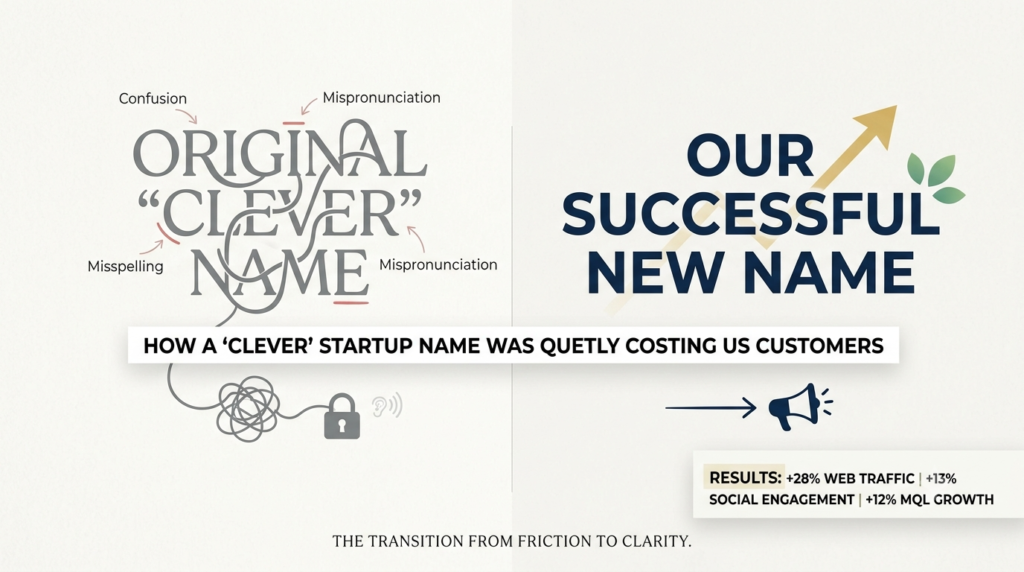
The original name seemed clever in founder discussions — wordplay and a backstory that impressed in pitch decks — but created problems everywhere else: prospects struggled to pronounce it on sales calls, conference attendees misread it off booth signage, and support calls regularly included customers apologizing before attempting to say it aloud, spelling it letter by letter. This wasn't a vague "the brand feels off" complaint — it was a consistent, repeatable, trackable pattern of friction at every customer touchpoint requiring trust.
Positioning
Before
A cleverly-named product that consistently created pronunciation, spelling, and recall friction across sales, support, and events — a name that worked in a pitch deck and worked against the company everywhere else.
After
Unizap — a name engineered to encode the company's real differentiators (speed and unification) so a first-time listener could reasonably infer what the product does, rather than a name optimized purely for memorability.
Messaging
Rather than hiring a naming agency to workshop something catchy, the team ran a company-wide roundtable — sales, support, product, and finance — around one question: what actually generates customer commitment and retention? Answers varied by department (deal velocity, fast issue resolution, consolidating five tools into one), but two concepts kept recurring: speed and unification. That pattern wasn't coincidental — it was the company's real, previously unarticulated competitive advantage, and it became the foundation the new name and every piece of rebrand messaging was built to carry.
Go-to-Market
The rename was treated as a positioning decision, not a cosmetic one. The relaunch went well beyond updating a logo — website, brand identity, and social presence were rebuilt from the ground up, all centered on the "fast, unified" narrative the new name now carried, with every relaunch element reinforcing that core story rather than applying surface-level changes to existing materials.
Sales Enablement
The rename was treated as a positioning decision, not a cosmetic one. The relaunch went well beyond updating a logo — website, brand identity, and social presence were rebuilt from the ground up, all centered on the "fast, unified" narrative the new name now carried, with every relaunch element reinforcing that core story rather than applying surface-level changes to existing materials.
Launch Assets
Brand Identity
Full brand identity system rebuilt around the new name and the 'fast, unified' positioning.
Website
Website reconstructed from the ground up to carry the new brand story, rather than receiving a logo swap onto existing materials.
Social
Social presence relaunched consistently with the new name and positioning across every channel.
Business Impact
+28%
Website traffic
Increase in website traffic following the rebrand launch.
+13%
Social engagement
Increase in social engagement following the new name and brand identity.
+12%
MQL growth
Increase in marketing-qualified lead volume following the rebrand.
Lessons Learned
A name isn't decorative — when it's misaligned with what a company actually does, it creates measurable friction across every go-to-market motion, not just brand perception. The fix isn't a naming agency workshopping something catchy in isolation; it's identifying the company's real, cross-functionally validated differentiators first, then engineering a name that carries that truth, so the name does real communicative work instead of just sounding good in a pitch deck.