Sampad Xavier Chaudhuri

Sampad Xavier Chaudhuri is a Revenue-Aligned GTM, Brand & Growth Leader with experience building marketing systems across Manufacturing, B2B Technology, SaaS, Retail Tech, and Food Tech. He specializes in positioning, go-to-market strategy, demand generation, and brand growth, helping organizations transform fragmented marketing efforts into scalable growth engines. His work has generated 50M+ impressions, 45K+ leads, and supported business growth across India, Europe, North America, and global export markets. Based in Mumbai, Sampad writes about positioning, GTM strategy, marketing systems, and growth leadership through the lens of Story × Systems × Scale.

Deeksharambh_2026_Guest_Lecture_St_Xavier's_College_Autonomous_Kolkata_Sampad1

Case Study: “Choosing Marketing as a Career”

Deeksharambh 2026 — Guest Lecture, St. Xavier’s College (Autonomous), Kolkata Speaker: Sampad Xavier Chaudhuri, ACIM — Marketing Manager, AVI Global Plast Pvt. Ltd. Host: Postgraduate & Research Department of Commerce, St. Xavier’s College (Autonomous), Kolkata Audience: M.Com Semester I students (Deeksharambh — Student Induction Programme) Format: 45-minute closing special lecture, designed as an interactive discussion rather than a one-way talk Role: Invited industry speaker, distinguished alumnus 📄 Full Speech Transcript: Google Drive 🖥️ Presentation Deck: Google Drive  The Brief The Department of Commerce invited me back to my alma mater to deliver the closing session of Deeksharambh 2026, the induction programme for incoming M.Com Semester I students. The brief from the department was simple on paper and hard in practice: inspire a room of first-semester students — many of whom had just landed in a Marketing programme without necessarily choosing it as a first preference — to see marketing as a genuine, credible career path. The session had to be interactive, not a lecture, and run to a tight 45-minute window. The Challenge Most students walk into a first-semester induction session with one of two postures: polite disengagement, or a set of assumptions about “marketing” that don’t hold up — that it’s just social media and advertising, that it lacks the analytical rigor of finance or the technical depth of other fields, and that a clear, obviously-correct career path exists for everyone except them. Add to that: this was the very last session of the day, competing with fatigue after a full induction schedule. The task, essentially, was a positioning problem — the same kind I solve professionally. I had 45 minutes to reposition an entire discipline in the minds of an audience that had already formed an opinion about it, using structure, credibility, and participation instead of just claims. The Approach Rather than open with credentials, I opened with a demonstration. The session was built around a single structural device: the 4Ps of marketing, shown first at the smallest possible scale, then scaled up to global brands — used as a bookend for the entire talk. 1. The Hook — A Sabzi Mandi The session opened not with an introduction, but with a question: what’s the most practiced profession in the world? The answer — marketing — was demonstrated through the everyday behavior of a local vegetable vendor: competitive pricing, sampling, bundling, cross-selling, and deliberate stall placement. This grounded an abstract framework (Product, Price, Promotion, Place) in something every student in the room already intuitively understood, before a single technical term was introduced. 2. Personal Credibility — Not the Plan Rather than lead with a resume, the session included an honest account of a career that wasn’t linear: originally on track to become a Chartered Accountant, a Covid-cancelled exam led to an unplanned application to the M.Com Marketing programme — the same one the audience had just joined. This was a deliberate credibility choice: relatability over polish, positioning the speaker as someone who once sat exactly where the audience was sitting. 3. The Real Case — AVI Global Plast The core of the session was a real, structured case study from current work: managing global marketing across 33 countries and six continents for a manufacturing and export business. The specific problem — 8,500 SKUs being offered indiscriminately across all 33 markets, an approach nicknamed internally the “bhagwan bharose sale” (the “God-willing” sale) — was broken down into a clear decision framework: Mapping all 8,500 designs against every market using a 2×2 product-marketing mix Deliberately narrowing focus to one high-margin product per new market, rather than spreading budget thin Rebuilding go-to-market infrastructure around that focus: multilingual websites, account-based marketing (ABM) campaigns, and real channel-level tracking Layering in events (6 cities globally), PR and trade-press thought leadership, targeted paid campaigns, and organic LinkedIn growth (2% to 23% engagement) The case closed on an external, verifiable outcome: recognition as one of India’s top exporters, an award presented by Piyush Goyal, India’s Commerce and Industry Minister — a business result validated outside the marketing function itself. 4. Personal Branding for Freshers The session pivoted from corporate strategy to something directly actionable: how a first-semester student markets themselves. This was framed around a personal example — eight internships across different marketing functions and roughly 195 online certifications during the speaker’s own studies — and a simple, honest pitch used with hiring managers: “I’m not an expert, but I’m resilient enough to learn.” Three concrete, semester-one-appropriate actions were given: starting accessible certifications (Udemy, LinkedIn Learning), building a portfolio of self-initiated case studies rather than relying on a transcript, and being honest about what’s genuinely difficult about the field. 5. The Close — Full Circle The session closed by returning to the opening device: the same 4Ps, now mapped against Apple — premium product design, deliberately high aspirational pricing (with a direct, audience-specific callback to waiting for Big Billion Days sales), global keynote-driven promotion, and deliberate retail placement. The structural bookend reinforced the session’s central thesis in the final minute: marketing is demand generation for a sale that hasn’t happened yet — shaping perception before a decision is ever made. 6. Open Floor The remaining time was handed entirely to the room — an unscripted Q&A covering salary expectations, whether an MBA is necessary, and what the job is actually like day to day. The Outcome The session ran as the closing lecture of the induction programme and was structured to maximize engagement over information density — a deliberate trade-off, given the audience and the time slot. Student response was strong: the open floor produced sustained, curious questions rather than the polite silence often typical of a day’s final session, and several students stayed back afterward to continue the conversation one-on-one. More broadly, the session served as a live demonstration of its own thesis — using positioning, structure, and a consistent narrative device (the 4Ps bookend) to make an abstract subject concrete for a specific, skeptical audience, exactly as described in the AVI case study

Case Study: “Choosing Marketing as a Career” Read More »
𝐓𝐡𝐞 𝐝𝐚𝐲 𝐌𝐢𝐜𝐫𝐨𝐬𝐨𝐟𝐭 𝐰𝐞𝐧𝐭 𝐝𝐨𝐰𝐧, 𝐈 𝐝𝐢𝐝𝐧'𝐭 𝐩𝐨𝐬𝐭 𝐚 𝐡𝐨𝐭 𝐭𝐚𝐤𝐞. 𝐈 𝐩𝐨𝐬𝐭𝐞𝐝 𝐚 𝐜𝐡𝐚𝐥𝐥𝐞𝐧𝐠𝐞 Sampad

I Turned a Global Microsoft Outage Into 30,920 Impressions. Here’s the One Number That Actually Mattered.

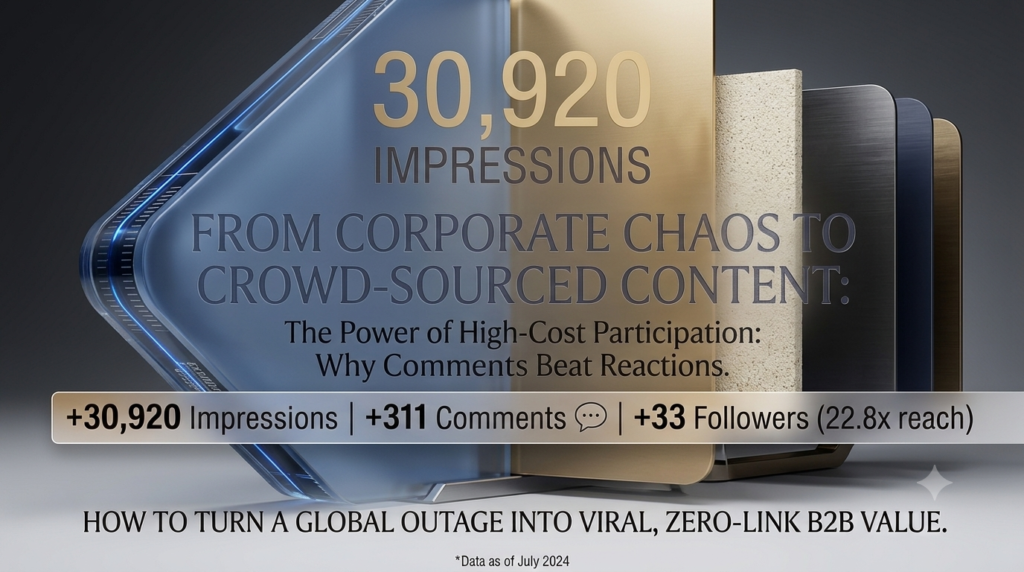
In July 2024, a bad CrowdStrike update took down Windows machines around the world. Blue screens everywhere. Flights grounded. Xbox Live down. For about a day, it was the only thing anyone in tech was talking about. Every marketer’s LinkedIn feed filled up with the same three posts: the screenshot, the “this is why cybersecurity matters” thread, the hot take about resilience. I posted something else. A challenge. I put the actual news headline next to the blue screen and asked one question: if you had to write this headline, what would you write? Short. Sweet. Relatable. Best answer wins ₹500. Deadline: midnight, same day. No brand. No product. No link to click. It pulled 30,920 impressions off a personal page with 1,356 followers — 22.8 times my own reach — and 311 comments against just 74 reactions. That ratio is the entire story, and it’s worth actually unpacking, because most people look at the impressions number and miss it. A like and a comment are not the same thing Reacting to a post costs a reader nothing. One tap, no thought required. Commenting costs something — a few seconds spent actually coming up with a line worth posting. On a normal post, reactions outnumber comments by a wide margin. That’s just how passive scrolling works. This post ran the opposite way, and not by accident. There was nothing to react to. The post didn’t work unless you answered it. That distinction matters more than it sounds like it should, because LinkedIn’s own distribution rewards comments far more than it rewards reactions. Build a post where commenting is the only way to participate, and you’ve made the platform’s algorithm do your distribution for you. Why this beat every well-written post I’ve ever put up I’ve spent real time crafting posts that did a fraction of these numbers. The difference here wasn’t better writing. It was that this post asked for participation, not attention. Attention is passive. Someone either notices you or they don’t. Participation is active — it asks someone to produce something, even something tiny, to be part of it. A one-line headline in the comments is a low bar. But it’s still a bar. And clearing a bar, however small, is what turns a scroller into a commenter. The prize and the deadline weren’t just decoration either. ₹500 isn’t “get rich” money, but it’s enough to make the ask feel real. Midnight isn’t “sometime this week” — it’s a clock. Clocks make people write the line now, instead of bookmarking the post and forgetting about it. The wrong lesson to take from this Don’t read this as “run more giveaways” or “jump on every trending topic.” Neither is the point. A prize-and-deadline challenge does one specific job: it converts people who are already paying attention to something — a news event, a shared moment — into people who briefly act inside your comment section. It’s not a funnel. It doesn’t explain a product or move anyone toward a purchase. It builds reach and a small spike in followers, because the format itself is worth engaging with, independent of who’s posting it or what they sell. For a product marketer, that’s a distinct and useful tool — separate from, not a replacement for, content that actually moves someone through a buying decision. What I’d change if I ran it again Mostly the follow-through, not the format. I had nothing ready to catch the 145 profile visitors or the 33 new followers this pulled in. No pinned post, nothing obvious for them to look at next. And I had no second post ready to test while that same wave of attention was still moving. A spike at over 20 times normal reach is the audience telling you, specifically, what they’ll respond to. The right move is to test that again immediately — not admire it a few weeks later, which is what I actually did. The actual takeaway Reach follows participation. It doesn’t work the other way around. A post that requires the reader to produce something — even one line, even something as small as a headline — will consistently beat a post that only asks to be noticed, as long as the ask is small enough and the moment is real enough that people act on it now instead of later. If you’re deciding whether a format like this is “too gimmicky” for a professional page, don’t look at the impressions count. Look at the comment-to-reaction ratio. If comments outnumber reactions, your audience didn’t just see the post. They did something with it. You can find the original post here.

I Turned a Global Microsoft Outage Into 30,920 Impressions. Here’s the One Number That Actually Mattered. Read More »

What a 92.12% Engagement LinkedIn Post Taught Me About Product Marketing Sampad

What a 92.12% Engagement LinkedIn Post Taught Me About Product Marketing

Last Christmas, we put up a post on AVI Global Plast’s LinkedIn page. No product shot. No feature list. No CTA. Just photos from our office party — Secret Santa, cake cutting, a manger scene the team built out of recycled plastic and leftover packaging material. A short caption. A few hashtags. It hit a 92.12% engagement rate. For context: LinkedIn’s own benchmark for organic B2B posts sits somewhere around 2–5%. We were at 92%. Not a typo, not a boosted post, not a giveaway. Organic, unpromoted, on a page with 6,804 followers. 3,222 impressions. 2,968 engagements. 2,878 clicks. An 89.32% click-through rate on an organic post from a rigid packaging manufacturer. I want to be honest about why, because “authenticity wins” is the kind of thing everyone says and almost nobody unpacks. We didn’t set out to make a sustainability post That’s the part I’d get wrong if I retold this too neatly. We didn’t sit down and plan “let’s demonstrate our values through employee storytelling.” Someone built a manger scene out of scrap plastic because that’s what was lying around the office. We photographed the party because it happened. The sustainability angle was already sitting inside the photo — we didn’t have to write it in. That’s a different thing from a company deciding to run a sustainability campaign and then staging a photo to fit it. Audiences on LinkedIn are unusually good at telling the difference between a value that’s being demonstrated and one that’s being performed. This one wasn’t performed. It just happened to also be true. Why this beat our product content, specifically Our product posts — PET sheet specs, thermoforming line capabilities, certification announcements — do fine. They get seen by the people already looking for a packaging vendor. That’s a narrow audience by design, and it should be. This post wasn’t talking to that audience. It was talking to anyone who’s ever worked in an office, celebrated with a team, or cared about where waste ends up. That’s a much bigger addressable audience, and it’s why the impression-to-engagement ratio looks the way it does — the content wasn’t asking for narrow relevance, it was asking for a much broader kind of recognition. The mistake would be concluding “we should post more culture content instead of product content.” That’s not the takeaway. The takeaway is that they’re doing two different jobs. Product content moves someone through a buying decision. This kind of post builds the reputation someone is relying on before they ever start that buying decision — including with people who will never buy packaging from us but might refer someone who does, or apply for a job here, or mention us to a supplier. What I’d actually change if I ran this again Not the content — the follow-through. We didn’t have anything ready to catch the attention once it arrived. No comment prompting a reply. No shorter opening line to hold people in the first two seconds. No version of this as a 20-second video, which almost certainly would have outperformed the static images given how the engagement curve looked. The bigger miss: we didn’t have a second post ready to ride the same attention. When something organic performs at 20x benchmark, that’s a signal the audience is telling you something specific about what they want to see from the page. We let that signal sit unused for a few months instead of immediately testing a follow-up. The actual lesson, stated plainly An unmeasured win teaches you nothing. We only know this post did 92% because tracking was already in place — the same tracking discipline that’s behind everything else we’ve built on the marketing side this year. A number like 92.12% is only useful because we have a baseline to compare it against, and other posts to compare it to. If you’re a B2B manufacturer wondering whether “soft” content like this is worth the slot on your content calendar next to your product posts — it is, but not because it’s more likeable. It’s worth it because it’s doing a job your product content structurally can’t: building the reputation that gets referenced long before anyone is in a buying cycle. Measure it the same way you measure everything else, and let the numbers tell you what to do next, rather than deciding in advance what kind of post you’re “supposed” to be. You can find the original post here.

What a 92.12% Engagement LinkedIn Post Taught Me About Product Marketing Read More »

Nobody Was Tracking Anything. So Nobody Could Optimize Anything-Sampad

Nobody Was Tracking Anything. So Nobody Could Optimize Anything

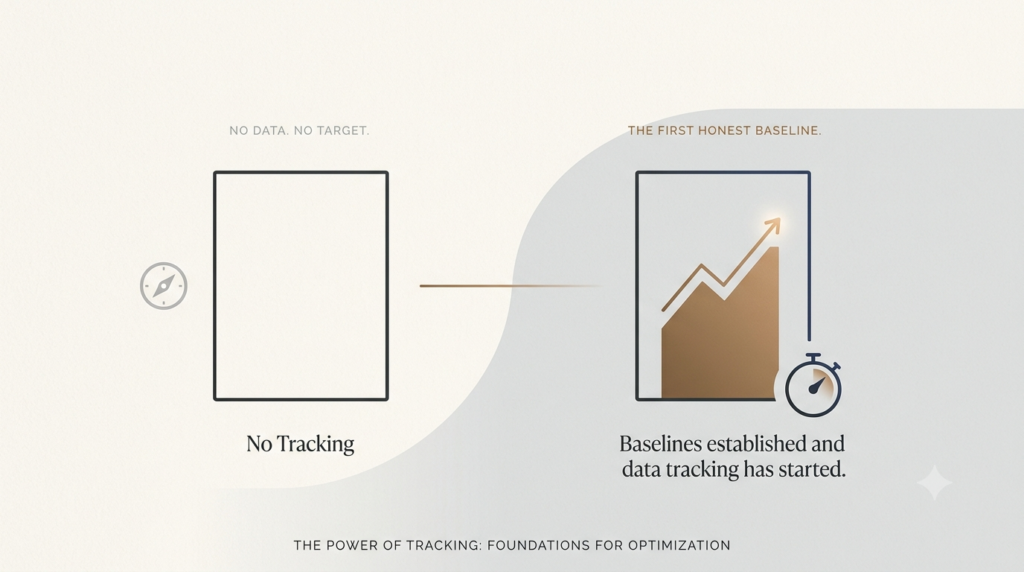
A different kind of starting problem When I joined AVI Global Plast — a ₹300Cr export manufacturer operating across 33 countries and 6 continents — nobody was tracking anything. That’s worth sitting with for a second, because it’s a different problem than the one most marketers walk into. Bad numbers are fixable. A weak conversion rate, a mediocre engagement rate, a high bounce rate — all of that gives you something to work against. What we had instead was no data, no dashboards, and no one anywhere in the business responsible for what any channel was actually producing. That’s not a strategy gap. It’s a measurement gap, and it sits underneath every strategy decision a marketing function tries to make. You can’t prioritize channels you’re not measuring. You can’t prove a campaign worked if you never had a number before it ran. You can’t even have a productive argument about what “good” looks like, because there’s nothing on the table to argue about. Why no one owning tracking was the real problem Every channel — the website, email, social, event lead capture — had been operating for years with no owner attached to its output. Not underperforming against a target. Simply unmeasured, which meant there was no target to underperform against in the first place. This is a subtler problem than it sounds, because a business can run for a long time this way without anyone noticing anything is wrong. AVI had a strong reputation and 25 years of export relationships built entirely without anyone tracking marketing performance — the absence of data doesn’t necessarily show up as an obvious crisis, it just quietly caps how much any future effort can be justified, prioritized, or improved. Closing that gap had to come before any other marketing decision, because every other decision depends on it. Tracking before optimizing, not the other way around The instinct walking into a role like this is to start fixing things immediately — new website copy, a fresh campaign, a rebuilt email sequence. We deliberately didn’t start there. Before touching a single channel, we put tracking in place across all of them: website analytics, email open and click tracking, social performance measurement, and lead capture attribution from events. The reasoning is simple but easy to skip under pressure to show quick wins: you cannot know whether a change worked if you never had a number before you made it. Optimizing without a baseline isn’t optimization — it’s just activity, with no way to tell afterward whether it helped, hurt, or did nothing at all. Letting the first honest number set the baseline Once tracking existed, the first numbers weren’t always flattering, and that’s exactly as it should be. An unflattering number you can act on is infinitely more useful than no number at all. The value of a baseline isn’t in how good it looks — it’s in the fact that it exists, and that everything measured afterward can be compared against it honestly. Every optimization after that is the same mechanism, repeated Once tracking was in place, every improvement that followed across every channel wasn’t really a series of separate clever tactics. It was the same underlying mechanism doing its job, over and over: show where the gap is, take an action, measure whether the action closed the gap. Website changes, email sequence adjustments, social content shifts — different tactics, same loop. The tracking is what turned isolated efforts into a system that compounds. Why infrastructure comes after the discipline, not before it Tools don’t create the habit of measuring — they scale it once it already exists. Building the tracking discipline first meant that whatever systems came next, whenever they arrived, would reinforce a way of working the team already trusted, rather than trying to manufacture that habit from scratch around a new piece of software. Sequencing it that way is what makes infrastructure investments actually stick instead of becoming another underused tool. The takeaway The biggest constraint on a marketing function isn’t usually a bad number. It’s the absence of any number to measure against, argue with, or improve. Once that gap closes — even with numbers that aren’t flattering at first — everything that follows becomes dramatically easier to prioritize, justify, and prove. That’s the real foundation any optimization work gets built on, and it has to come first, not as an afterthought once the “real” marketing work is already underway.

Nobody Was Tracking Anything. So Nobody Could Optimize Anything Read More »

Our Clever Startup Name Was Quietly Costing Us Customers When a name stops being an asset - Sampad

Our Clever Startup Name Was Quietly Costing Us Customers

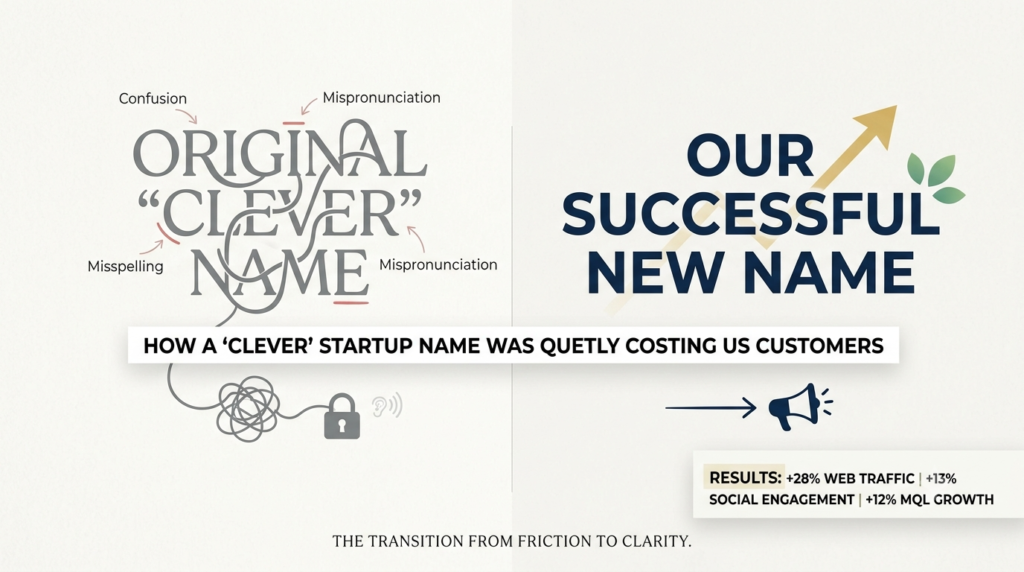
When a name stops being an asset At a retail-tech SaaS I worked at, the original product name sounded clever in the founders’ room. It had a story behind it, a bit of wordplay, the kind of name that gets nods of approval in an early pitch deck. It fell apart everywhere else. On sales calls, prospects would repeat it back to us, unsure if they’d got it right. At industry conferences, people misread it off our own booth signage. On support calls, customers would apologize before even attempting to say it out loud, then just spell it out letter by letter. It became something people joked about — and not the kind of joke that helps you close a deal or get remembered after a trade show. We didn’t rebrand because the name felt dated or because a founder got bored of it. We rebranded because the name had quietly become friction at every single touchpoint where a prospect or customer needed to trust us enough to say our name out loud, type it into a search bar, or recommend us to a colleague. The first signal: watch what breaks, not what feels off The instinct when a name isn’t landing is to treat it as a vague aesthetic problem — “it doesn’t feel right anymore.” That’s not a useful diagnosis. What we actually had was a pattern of very specific, very repeatable friction: mispronunciation on calls, misspelling in inbound emails, confusion at events, an awkward beat every time someone had to introduce us to someone else. None of that shows up in a brand survey asking “how do you feel about our name.” It shows up in call transcripts, support tickets, and the slightly embarrassed pause before a customer tries to say your name to their own boss. Once we started tracking it as an actual pattern rather than a vibe, it was obvious the name itself was a tax on every single go-to-market motion running through the business — sales, support, events, referrals, all of it. Don’t guess the fix. Ask the whole company The temptation at that point is to hand the problem to a naming agency and let them workshop something catchy. We did something slower and, in hindsight, far more useful first: we ran a company-wide roundtable. Not a marketing offsite — everyone who talked to a customer or prospect in any capacity was in the room. Sales, support, product, even people from finance who fielded vendor calls. The question was simple: what do we actually win on? Not what we say in our pitch deck — what genuinely gets a prospect to say yes, and what makes an existing customer stay. Finding the pattern underneath the noise Everyone answered differently at first. Sales talked about deal velocity. Support talked about how quickly issues got resolved. Product talked about how the platform pulled every sales channel into one place instead of forcing customers to stitch five tools together themselves. Different words, but two ideas kept resurfacing no matter who was speaking: speed, and unification. That wasn’t a coincidence — it was the company’s actual competitive advantage, sitting in plain sight, just never articulated as a single, shared answer before. Everyone had a piece of it. Nobody had said the whole thing out loud as one sentence. Building a name that carries the answer Once we had that — speed and unification as the two ideas that mattered most, backed by input from every team that touched a customer — the new name wasn’t a creative brainstorm exercise anymore. It was almost an engineering problem: build a name that encodes those two ideas clearly enough that someone hearing it for the first time could take a reasonable guess at what the product actually does. That’s a fundamentally different design brief than “pick something that sounds cool.” The old name had been chosen for cleverness. The new one was chosen because it did actual communication work — it told people something true about the product before they’d read a single word of copy. Treating the rename as a positioning decision, not a cosmetic one The rollout wasn’t just a new logo dropped onto the same website. We rebuilt the website, the brand identity, and the social presence from zero, all built around the same “fast, unified” idea the new name now carried. Every piece of the relaunch reinforced the same story the roundtable had surfaced, instead of just changing the wordmark and leaving everything else to catch up later. Results +28% website traffic, +13% social engagement, and +12% MQL growth in the period following the rebrand. The takeaway A name isn’t a decorative layer sitting on top of the real work of positioning — when it’s wrong, it’s active friction against every other GTM motion a company runs, and that friction is measurable if you look for it in the right places: call transcripts, event feedback, support tickets, not brand sentiment surveys. And when it’s time to fix it, the answer isn’t a naming consultant’s word list. It’s asking the people who talk to your customers every day what you actually win on, and having the discipline to build the name around their answer instead of your own cleverness.

Our Clever Startup Name Was Quietly Costing Us Customers Read More »

We Priced a Rebrand Off Willingness-to-Pay Research, Not Competitor Copy-Paste-Sampad

We Priced a Rebrand Off Willingness-to-Pay Research, Not Competitor Copy-Paste

The default path we didn’t take At a retail-tech SaaS I worked at, we rebranded the product — new name, new visual identity, new positioning, new website and social presence built from scratch. Somewhere in that process, the pricing conversation started the way it starts almost everywhere: open three competitor pricing pages, eyeball where they land, pick a number somewhere in the middle, call it “market rate.” We stopped that conversation before it went anywhere. It’s the single decision from the entire rebrand I’d defend most confidently, because it was the one built on the least amount of guessing. Why competitor pricing pages are a trap Competitor pricing tells you what another company believes their buyer will pay, filtered through their own cost structure, their sales motion, their brand equity, and their existing customer base’s switching cost. None of that transfers cleanly to a company mid-rebrand, with a new name buyers don’t recognize yet and none of the trust an established competitor has already banked. We still did deep competitive intelligence — feature matrices, positioning gaps, messaging audits — because understanding what competitors offered and how they talked about it mattered for product and GTM decisions. What we refused to do was let their price tag become our starting point. Anchoring to a competitor’s number answers the wrong question: it tells you what they charge, not what your buyer will actually pay for your specific version of the value proposition. What we did instead We didn’t run a formal, single-instrument willingness-to-pay study. What we ran was messier and, in hindsight, more honest: a continuous willingness-to-pay process built on real conversations rather than a survey instrument. Sales was already running when I joined, and I spent a significant amount of time sitting in on live sales calls — watching how prospects actually reacted to a price in the moment, not what they said they’d pay in the abstract. That unfiltered, in-context reaction turned out to be more reliable than anything a structured questionnaire would have told us, because it was revealed behavior, not a hypothetical answer. Alongside that, we ran direct interviews with existing customers, and we used competitive intelligence — feature matrices, positioning gaps — to shape our initial bundling. None of this happened in a single clean phase before launch. It happened continuously, in parallel with ICP and persona work, as we onboarded new customers and learned more. The output was never a single number handed over by a research report. It was a live feedback loop — sales call data, customer interviews, and real market response, compounding into a clearer picture of what different segments would actually pay. Building the price ladder from segments, not features The common approach to SaaS tiering is to bundle features into “Basic / Pro / Enterprise” buckets and hope the segmentation falls out naturally. We built it the other way around. The willingness-to-pay signal we gathered — through sales conversations and customer interviews, not a formal survey — showed us where the real price ceilings sat for different buyer segments, and the tiers were built to match those segments, not to create artificial scarcity that pushes people toward an upsell. That distinction matters more than it sounds. Feature-bundled tiering optimizes for extracting more from each customer. Segment-based tiering, built from real buyer signal, optimizes for actually landing the price a given buyer is willing to pay in the first place — which matters enormously more when you’re a newly rebranded product still building trust. Ability-to-pay mattered as much as willingness-to-pay Our buyer base skewed heavily SMB, running on a freemium model. For that segment, budget reality was often the harder constraint — not whether they were willing to pay, but whether they structurally could. That distinction shaped the final tiers as much as any single conversation did. It’s a detail formal WTP frameworks sometimes miss: a segment can want your product and still have no room in their budget for it, and no amount of clever pricing psychology changes that math. Pricing below the incumbent, on purpose The signal pointed to a clear answer: price around 20% below the established mid-market players, and roughly 50% below the category leader. That wasn’t a discount strategy or a “let’s undercut everyone” reflex. It was where real buyer behavior told us our ceiling sat once we accounted for the trust deficit of a smaller, newly rebranded product asking someone to switch from something they already knew. Pricing lower than an incumbent without any signal behind it is just guessing downward. Pricing lower than an incumbent because sales conversations, customer interviews, and repeated iteration showed that’s genuinely where the value-to-trust ratio lands for your buyer is a decision you can defend in a board meeting — even if the process that got you there wasn’t a textbook study. Letting the rebrand carry the price The launch didn’t apologize for the number. New name, new identity, new website, new social presence — every touchpoint was built around the same positioning that justified the price, not around explaining why it was lower than the leader’s. Buyers weren’t told “we’re cheaper because we’re new.” They were told why this product, at this price, was built for exactly their use case. Results +28% website traffic, +13% social engagement, +12% MQL growth in the period following the rebrand. The takeaway Pricing research gets treated as something that only counts if it’s a formal study — a survey instrument, a fixed sample, a clean report. Done properly, willingness-to-pay work doesn’t have to look like that. Sometimes the most reliable signal is sitting in your sales calls and your actual market response, if you’re willing to iterate against it instead of guessing once and moving on. We repriced three times before we got it right. That’s not a weaker process than a formal study — it’s a different kind of rigor, built on revealed behavior instead of stated preference.

We Priced a Rebrand Off Willingness-to-Pay Research, Not Competitor Copy-Paste Read More »

Why Compliance Is About to Become a Competitive Moat in Indian Packaging - Sampad

Why Compliance Is About to Become a Competitive Moat in Indian Packaging

The rule most brand owners haven’t fully clocked yet On 31 March 2026, the Ministry of Environment, Forest and Climate Change notified the Plastic Waste Management (Amendment) Rules, 2026. The rules took effect immediately, from the date of gazette publication. Buried in the notification is a mandate that’s going to reshape how FMCG brands choose packaging partners over the next three years: minimum recycled content requirements for rigid plastic packaging, with real penalties and real audits behind them. For most brand owners, this has registered as background regulatory noise — another compliance box in a year full of them. That’s a mistake. This particular rule doesn’t just apply to how you dispose of packaging. It applies to what your packaging is made of, and it’s being enforced through your supply chain, not just your compliance department. What the rule actually requires The amendment sets a category-based, phased schedule for recycled plastic content: Category I (rigid packaging — HDPE, PET containers): 30% recycled content for FY 2025-26, increasing to 40% for FY 2026-27, 50% for FY 2027-28, and 60% by FY 2028-29 Category II (flexible packaging): 10% rising to 20% over the same period Category III (multi-layered packaging): 5% rising to 10% Alongside recycled content, the rules mandate reuse targets for rigid packaging: 10% for small containers (0.9-4.9 litres), scaling up to 70-85% for large water packaging formats by 2028-29. Two enforcement mechanisms make this materially different from earlier EPR rounds: Traceability: every unit of plastic packaging has required a QR code or barcode since January 2025, allowing regulators (and in principle, customers) to trace packaging back to the producer and verify recycled content and EPR registration status. Independent verification: the 2026 amendment introduces Registered Environmental Auditors, who verify EPR and recycled content claims directly. Self-reported, unverified compliance — which is how much of the market has operated so far — is no longer sufficient. Non-compliance penalties fall under the amended Environment Protection Act framework and can escalate into lakhs of rupees for serious violations. There’s some flexibility built in: producers can carry forward an unmet recycled content target for food-contact packaging for up to three years, provided at least a third of the shortfall is closed each year. It’s breathing room, not an exemption. Why this is a sourcing problem, not just a compliance problem Here’s the part that matters most for brand owners choosing a packaging partner right now: recycled content at food-grade quality isn’t a commodity that appears the moment demand shows up. Domestic supply of quality post-consumer recycled resin — PCR, rPET — is still developing relative to the scale this mandate now requires industry-wide. That creates a straightforward supply-and-demand problem. As the FY2026-27 requirement steps up to 40% and brands who deferred this decision start scrambling simultaneously, they’ll be competing for the same limited pool of certified recycled material and the same limited pool of packaging manufacturers who can actually prove traceable, audit-ready compliance. Brands that treat this as a Q4 fire drill will find themselves negotiating from a position of scarcity, not choice. The traceability requirement compounds this. It’s no longer enough for a packaging supplier to claim their material meets the recycled content threshold — that claim now has to be independently verifiable, tied to a QR code, and ready for an environmental auditor to check. A packaging partner who built traceability into their process only after the enforcement mechanism showed up is starting from a different position than one who built it in from the start. What being ahead of it actually looks like At AVI Global Plast, we integrated 100% rPET capability and digital traceability into our production well before this rule made it mandatory — work that was independently recognized by Starlinger viscotec as a high-performing PCR packaging leader in India. That’s not a claim we’re making to sound compliant. It’s a production capability that was already in place before the regulatory clock started running, which means our customers aren’t scrambling to retrofit a supply chain — they’re already positioned for FY 2026-27’s 40% threshold and beyond. For brand owners evaluating packaging partners over the next few quarters, the questions worth asking aren’t about intent. They’re about evidence: Can your supplier show traceable recycled content data today, not as a future roadmap? Can they demonstrate rPET sourcing at the volumes your brand needs, consistently, not as a pilot batch? Would their compliance documentation hold up to a Registered Environmental Auditor without a scramble? The takeaway Regulatory deadlines have a way of turning “nice to have” sustainability claims into hard procurement filters almost overnight. The Plastic Waste Management (Amendment) Rules, 2026 is doing exactly that to rigid packaging in India, on a schedule that’s already running. Brand owners who treat this as a sourcing decision now — evaluating packaging partners on demonstrable compliance capability rather than promises — will have real options as the thresholds climb. Those who wait will be shopping in a smaller, more expensive market of their own making. If compliance readiness isn’t part of your packaging partner conversation yet, it’s worth making it one before the next threshold does it for you.

Why Compliance Is About to Become a Competitive Moat in Indian Packaging Read More »

What Building Marketing in a ₹300 Crore Export Manufacturer Taught Me About GTM Sampad​ Sampad Xavier Chaudhuri

What Building Marketing in a ₹300 Crore Export Manufacturer Taught Me About GTM​

A year ago, AVI Global Plast didn’t have a marketing function. Just a 25-year-old reputation, a ₹300Cr export business spanning 33 countries, and zero structured demand engine. No CRM. No content calendar. No consistent messaging across the website, sales decks, and trade shows. Just a strong product and a market that already trusted the name — but had no systematic way of reaching new buyers, or reminding existing ones why they’d chosen AVI in the first place. Building that function from the ground up — across brand, demand generation, export GTM, and event strategy — taught me more about B2B go-to-market than any campaign I’d run before. Here’s what stuck. 1. Manufacturing buyers don’t respond to “marketing” — they respond to proof In consumer marketing, a clever campaign can shift perception overnight. In B2B manufacturing, it can’t — and trying to force it usually backfires. Procurement leads, NPD engineers, and supply chain directors aren’t evaluating you on creativity. They’re evaluating you on whether your spec sheets are accurate, whether your compliance documentation is complete, and whether your packaging will survive a transit audit three weeks from now in a different climate. The moment we stopped writing copy that sounded like a brochure — “industry-leading,” “world-class,” “trusted by thousands” — and started writing copy that read like an engineer explaining a process, conversations changed. Inquiries got more specific. Sales calls started further down the funnel, because the website had already answered the basic qualifying questions. The lesson: in industrial B2B, proof is the message. Confidence comes from precision, not adjectives. 2. Your biggest GTM lever might be a website nobody’s looked at in years When I started, the website’s bounce rate was sitting at 98%. Visitors were landing and leaving almost instantly. The instinct in most organizations would be a full redesign — new visuals, new branding, a bigger budget. We didn’t have that luxury, and honestly, it wasn’t the actual problem. The real issue was structural: the site wasn’t answering the questions a buyer actually has before they’re willing to fill out a contact form. What certifications do you hold? Can you handle our specific SKU dimensions? Do you export to our region? What does your compliance documentation look like? By restructuring content around those questions — without touching the visual design — bounce rate dropped from 98% to 47%. No redesign. Just better answers, in the right order, at the right depth. The lesson: before reaching for a redesign, ask whether your existing assets are actually solving the buyer’s information problem. Often, they’re not — and that’s a content and structure fix, not a design one. 3. Export GTM is 33 different micro-markets wearing one trench coat “33 countries across 6 continents” looks great on a slide. On the ground, it means 33 different sets of buying triggers, regulatory requirements, seasonal cycles, and competitive landscapes. What works for a North American berry exporter — fast turnaround, cold-chain compatibility, retail-ready packaging — doesn’t translate to an EU avocado packer, who’s thinking about recyclability mandates, different retailer specifications, and a completely different sourcing calendar. Treating “export markets” as one audience is one of the most common GTM mistakes in B2B manufacturing. It leads to generic messaging that resonates with no one, because it’s been averaged across buyers who have almost nothing in common except that they’re “international.” The fix wasn’t to build 33 separate strategies — that’s not feasible for a lean team. It was to group markets by buying behavior and product fit rather than geography, and build messaging variants for those clusters instead of treating “export” as a monolith. 4. Repositioning isn’t a tagline change One of our core shifts was moving from being perceived as a price-led thermoforming supplier to being recognized as a solution-led export partner. That’s an easy sentence to write and a genuinely hard thing to do — because positioning claims that aren’t backed by substance get ignored, or worse, actively damage credibility with sophisticated buyers who can tell the difference. Before we said a word about “solutions,” we had to be able to demonstrate the capability behind the claim: rPET integration, digital traceability, the ability to support custom development at speed. The recognition that followed — including being featured by Starlinger viscotec as a high-performing PCR packaging leader in India — wasn’t the result of better messaging. It was the result of the messaging finally catching up to capabilities that were already real. The lesson: positioning is a promise. Don’t make it until the operational reality can back it up — otherwise you’re just adding to the noise everyone else is already making. 5. A marketing function in manufacturing is built on trust capital, not creative capital Perhaps the biggest mindset shift: in this environment, marketing’s value isn’t measured primarily by creative output. It’s measured by how well marketing’s narrative matches what operations, sales, and leadership already know to be true. Every meaningful external validation we earned — the Plexconcil Top Exporter recognition, the Starlinger feature, the Sahyadri Farms partnership recognition — came from marketing and operations finally speaking the same language. Marketing wasn’t translating operational reality into a story from the outside; it was working with operations to find the story that was already there. That’s a very different posture from consumer marketing, where the brand often leads and operations follows. In industrial B2B, the brand earns the right to speak only once it accurately reflects what the business can actually deliver. The bigger picture Building marketing in export manufacturing isn’t glamorous. There’s no viral campaign moment, no overnight brand transformation. But it’s some of the most honest GTM work I’ve done — because the buyer on the other end isn’t making a snap purchase. They’re making a multi-year supply chain decision, often involving multiple stakeholders, compliance reviews, and sample testing cycles. When marketing respects that — when it prioritizes proof over polish, structure over spectacle, and alignment over creativity for its own sake — it stops being a cost center and starts becoming part of how the business actually grows. If

What Building Marketing in a ₹300 Crore Export Manufacturer Taught Me About GTM​ Read More »

The Vertical That Was Killing Our Retention — And What Replaced It — Sampad

The Vertical That Was Killing Our Retention — And What Replaced It

The problem, in one number At a retail-tech SaaS I worked at, our largest customer segment by count was grocery — kirana stores. It was also the segment with the highest churn, the thinnest margins, and the most discount pressure at every renewal. On paper, it looked like a growth story. In the P&L, it looked like a slow leak. This isn’t a company-specific quirk — it’s structural to the category. Kirana stores make up the overwhelming majority of India’s grocery retail; by most estimates, roughly 12 million stores account for around 90% of grocery sales. But digitization inside that base has historically been shallow — of India’s 12+ million kirana stores, industry estimates put the number with actual app-based digitized operations at around 15,000, a rounding error against the total. The easy conclusion was that kirana simply couldn’t afford software. The real answer took longer to find, and it wasn’t really about money. Diagnosing it correctly The instinct when a segment churns hard is to fix retention — better onboarding, win-back campaigns, loyalty perks. We tried versions of that. It didn’t move the number, because retention tactics can’t fix a mismatch that isn’t really about retention at all. So instead of asking “how do we keep these customers,” we asked a different question: what were they actually trying to do with the product, and why weren’t they willing to pay for it? Going back through support tickets, sales call notes, and onboarding drop-off data, the pattern that emerged wasn’t budget. It was substitution. An app-based storefront put a kirana store in direct competition with Blinkit and Zepto — for exactly the customers most likely to abandon them anyway: younger, convenience-first, price-agnostic shoppers who’d order from whoever showed up fastest. Meanwhile, the customers a kirana store could actually retain — older, relationship-driven, the kind who visit as much to talk as to shop — never wanted an app in the first place. WhatsApp, or a conversation at the counter, did that job better than any storefront we could build. In other words, kirana’s low willingness to pay wasn’t a budget problem. It was that the product was quietly competing with the one relationship kirana owners could actually keep, while doing nothing for the one they’d already lost. What we did about the pricing, not just the roadmap Once that was clear, forcing a paid tier onto kirana stopped making sense — we weren’t going to price our way into a channel mismatch. Instead, we kept the segment on a freemium model: free for kirana, monetized elsewhere. The founder’s original mission — bringing a huge number of India’s retailers online, kirana included — never changed. What changed was the economics underneath it. The mission stayed intact. The monetization got smarter. The vertical we ruled out — and why Pharmacy retail looked tempting on paper: a large, fragmented, still-digitizing base. We ruled it out anyway. Pharmacy retail requires drug-license and regulatory compliance credentials we didn’t hold, and layering that compliance burden onto a horizontal commerce platform would have meant building — and certifying — an entirely different product, not extending the one we had. Chasing total addressable market without the right to actually operate in it isn’t expansion. It’s a distraction with a bigger number attached. Where we went instead, and why We expanded horizontally into fashion, white goods, D2C brands, and manufacturing — and the case for each held up in the market data, not just in inbound lead volume. Fashion was the clearest growth bet. India’s online fashion retail market was valued at roughly $21.6 billion in 2025 and is projected to reach around $98 billion by 2032. Fashion sellers also needed heavier catalog and variant management than grocery ever did, which played directly to strengths we’d already built. White goods and D2C brands offered something grocery couldn’t: basket size. Higher transaction values meant sellers in these categories could actually absorb a software subscription without it being a rounding error against their margin — the exact problem we’d had with kirana. Manufacturing and B2B rode a genuinely large structural tailwind, with India’s B2B online marketplace opportunity estimated to reach roughly $200 billion by 2030 — underserved infrastructure, not a crowded consumer category. Each pick answered the same question differently: does this vertical have the workflow we already support, and can the buyer actually pay for it without competing against a relationship they’re not willing to give up? Results 2,500+ new customers onboarded across the expanded verticals, 80+ product gaps resolved, DAU/MAU up 12%, support ticket volume down 40%. The takeaway The biggest shift wasn’t a rebrand or a new campaign. It was recognizing that a high-churn segment isn’t always a pricing failure — sometimes the product is quietly asking a customer to pay for something that competes with the one relationship they actually value. Once we saw that, the fix wasn’t a better retention campaign. It was matching the model to the segment: freemium where the product was substitutive, paid where it was additive — and picking the next markets based on where we could actually serve the buyer, not the biggest numbers on a slide. If you’re staring at a segment that won’t stop churning no matter what you throw at it, it’s worth asking the same question we did: is this a pricing problem, or is the product quietly competing with something the customer isn’t willing to give up?

The Vertical That Was Killing Our Retention — And What Replaced It Read More »

BTIT2026-Sampad

What India’s Leading Brand Marketers Taught Me About Building Trust in B2B Markets​

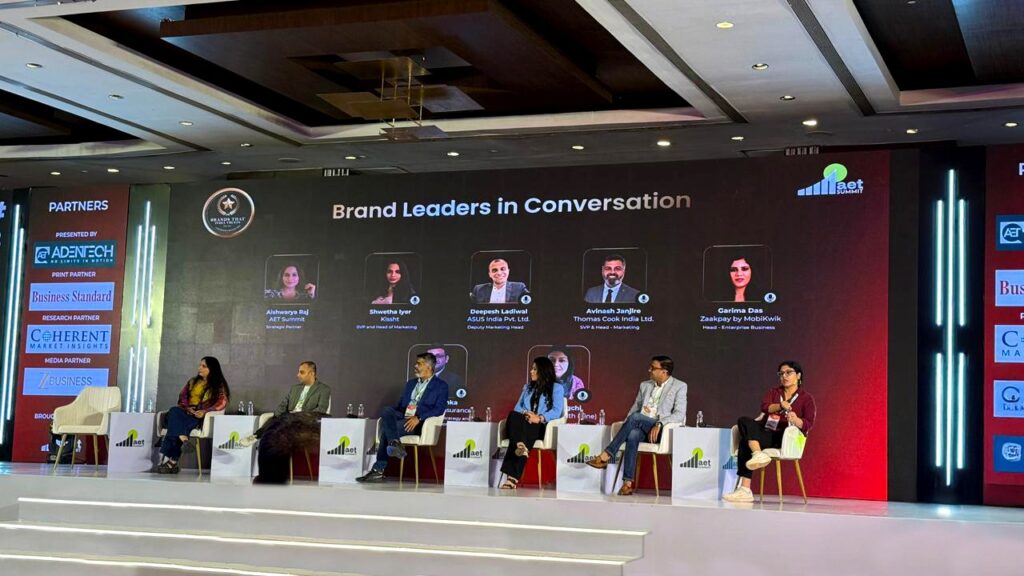
Can a B2B manufacturer build a brand that customers choose for more than just price? It’s a question I’ve been thinking about a lot over the past few months. Working in the packaging industry, I’ve realised that marketing in B2B manufacturing is fundamentally different from many consumer-facing industries. We don’t sell products that customers browse on a supermarket shelf, and we certainly don’t compete through flashy advertising campaigns. More often than not, customers compare suppliers based on quality, service, relationships—and unfortunately, sometimes even a difference of just a few paise. As someone currently building the marketing function at AVI Global Plast, this challenge has become one of the most interesting parts of my role. So when I attended the Brands That India Trusts Summit 2026 in Mumbai, I wasn’t looking for the latest marketing trend or another AI presentation. I wanted to understand how experienced brand leaders think about trust, differentiation, and long-term brand building—and whether those lessons could be applied to B2B manufacturing. Interestingly, by the end of the event, I realised that although the speakers represented industries as diverse as insurance, fintech, media, travel, healthcare, and consumer brands, many of the principles they discussed were surprisingly relevant to the challenges we face in industrial marketing. Trust Is Built Across Every Customer Touchpoint One idea kept resurfacing throughout the day: brands don’t earn trust through a single campaign. They earn it through consistency. That sounds simple, but it completely changes the way we think about marketing. In manufacturing, trust doesn’t begin when someone sees a LinkedIn post or visits a website. It begins when they make their first enquiry. It grows through timely responses from the sales team, accurate production timelines, consistent product quality, transparent communication, reliable deliveries, and responsive after-sales support. Every department contributes to the customer’s perception of the brand. As marketers, we often think about messaging, positioning, and content. The event reminded me that these are only one part of the equation. Marketing creates expectations. The business fulfils them. When every customer interaction reflects the same level of professionalism and consistency, trust begins to compound over time. The Real Opportunity Is Creating Value Beyond the Product One of the most valuable conversations I had after the panel discussions was around a challenge I face regularly. I explained that in our domestic market, customers often compare suppliers based on extremely small price differences. If one supplier quotes ₹4.23 and another quotes ₹4.25, procurement decisions can sometimes be influenced by those few paise. It raises a difficult question for any marketer: how do you build preference in a market where products are often treated as commodities? The advice I received was both simple and powerful. Instead of asking how to make the product appear different, ask what additional value the brand can create around the product. That completely changed my perspective. Perhaps differentiation doesn’t always come from changing the product itself. Perhaps it comes from becoming a better partner. Sharing industry knowledge, educating customers, providing technical expertise, helping them understand market trends, or creating better customer experiences may ultimately become stronger competitive advantages than trying to compete purely on price. Products can often be copied. Relationships rarely can. Customer Experience Is One of Marketing’s Strongest Assets Another recurring theme throughout the summit was customer experience. Traditionally, customer experience is often associated with service teams or operations. However, several speakers emphasised that customers don’t experience departments—they experience one brand. That observation stayed with me. Every email, every production update, every delivery, every service interaction, and every problem resolved contributes to how customers remember an organisation. For B2B companies, customer experience isn’t something that happens after marketing. It is marketing. It also made me reflect on something we can continue strengthening in manufacturing businesses. Building stronger alignment between marketing, sales, production, and customer support creates a far more consistent customer journey than any campaign ever could. Communities Build Stronger Brands Than Campaigns Perhaps the most interesting idea discussed during my conversations with the panelists was creating value beyond transactions. Rather than viewing customers only as buyers, why not create opportunities for them to engage with the company in different ways? Client meet-and-greets. Knowledge-sharing sessions. Industry roundtables. Packaging innovation workshops. Plant visits. Thought leadership events. These aren’t simply marketing activities. They create conversations, strengthen relationships, and position the company as a trusted industry partner rather than another supplier competing for orders. For B2B organisations, that shift from supplier to trusted advisor can make a significant difference over time. Sometimes the Best Marketing Lessons Come From Other Industries One conversation that particularly stood out to me was with a customer experience leader from the insurance industry. On the surface, insurance and packaging appear to have very little in common. But as we discussed customer trust, I realised they face remarkably similar challenges. Neither industry succeeds purely because of advertising. Both rely heavily on credibility, consistency, relationships, and delivering on promises over time. Customers ultimately choose organisations they believe will perform when it matters most. It reminded me that some of the best ideas don’t always come from companies within your own industry. Looking outside your category often reveals principles that can be adapted in surprisingly effective ways. My Biggest Takeaway Wasn’t About Marketing Ironically, the lesson that stayed with me the most wasn’t about branding or campaigns. It was about careers. Looking around the room, I realised that many of the people sharing their experiences had spent fifteen or twenty years building their expertise before becoming Heads of Marketing, Directors, CEOs, or business leaders. As someone who became a first-time marketing leader within four years, that perspective was incredibly grounding. Like many young professionals, it’s easy to focus on titles and the next promotion. The summit reminded me that great marketers aren’t defined by how quickly they become leaders. They’re defined by how consistently they learn, adapt, solve problems, and continue improving over time. That may have been the most valuable lesson I brought home. Final Thoughts I attended Brands That

What India’s Leading Brand Marketers Taught Me About Building Trust in B2B Markets​ Read More »