Case Study: “Choosing Marketing as a Career”
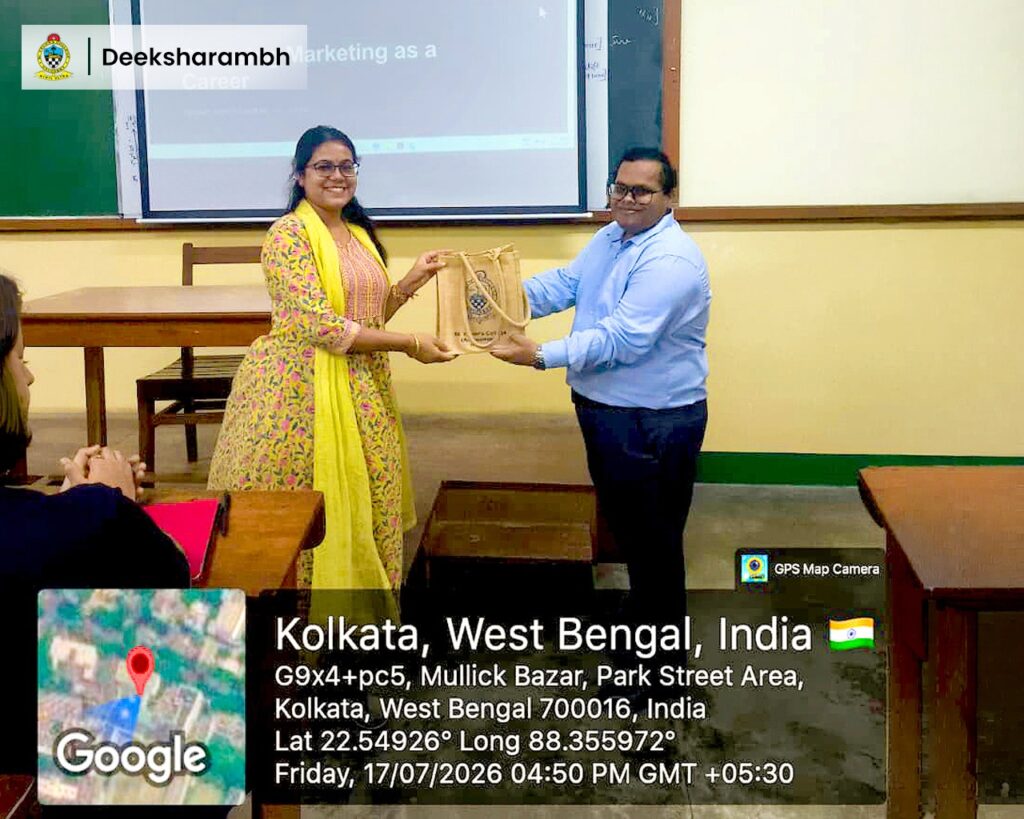
Deeksharambh 2026 — Guest Lecture, St. Xavier’s College (Autonomous), Kolkata Speaker: Sampad Xavier Chaudhuri, ACIM — Marketing Manager, AVI Global Plast Pvt. Ltd. Host: Postgraduate & Research Department of Commerce, St. Xavier’s College (Autonomous), Kolkata Audience: M.Com Semester I students (Deeksharambh — Student Induction Programme) Format: 45-minute closing special lecture, designed as an interactive discussion rather than a one-way talk Role: Invited industry speaker, distinguished alumnus 📄 Full Speech Transcript: Google Drive 🖥️ Presentation Deck: Google Drive The Brief The Department of Commerce invited me back to my alma mater to deliver the closing session of Deeksharambh 2026, the induction programme for incoming M.Com Semester I students. The brief from the department was simple on paper and hard in practice: inspire a room of first-semester students — many of whom had just landed in a Marketing programme without necessarily choosing it as a first preference — to see marketing as a genuine, credible career path. The session had to be interactive, not a lecture, and run to a tight 45-minute window. The Challenge Most students walk into a first-semester induction session with one of two postures: polite disengagement, or a set of assumptions about “marketing” that don’t hold up — that it’s just social media and advertising, that it lacks the analytical rigor of finance or the technical depth of other fields, and that a clear, obviously-correct career path exists for everyone except them. Add to that: this was the very last session of the day, competing with fatigue after a full induction schedule. The task, essentially, was a positioning problem — the same kind I solve professionally. I had 45 minutes to reposition an entire discipline in the minds of an audience that had already formed an opinion about it, using structure, credibility, and participation instead of just claims. The Approach Rather than open with credentials, I opened with a demonstration. The session was built around a single structural device: the 4Ps of marketing, shown first at the smallest possible scale, then scaled up to global brands — used as a bookend for the entire talk. 1. The Hook — A Sabzi Mandi The session opened not with an introduction, but with a question: what’s the most practiced profession in the world? The answer — marketing — was demonstrated through the everyday behavior of a local vegetable vendor: competitive pricing, sampling, bundling, cross-selling, and deliberate stall placement. This grounded an abstract framework (Product, Price, Promotion, Place) in something every student in the room already intuitively understood, before a single technical term was introduced. 2. Personal Credibility — Not the Plan Rather than lead with a resume, the session included an honest account of a career that wasn’t linear: originally on track to become a Chartered Accountant, a Covid-cancelled exam led to an unplanned application to the M.Com Marketing programme — the same one the audience had just joined. This was a deliberate credibility choice: relatability over polish, positioning the speaker as someone who once sat exactly where the audience was sitting. 3. The Real Case — AVI Global Plast The core of the session was a real, structured case study from current work: managing global marketing across 33 countries and six continents for a manufacturing and export business. The specific problem — 8,500 SKUs being offered indiscriminately across all 33 markets, an approach nicknamed internally the “bhagwan bharose sale” (the “God-willing” sale) — was broken down into a clear decision framework: Mapping all 8,500 designs against every market using a 2×2 product-marketing mix Deliberately narrowing focus to one high-margin product per new market, rather than spreading budget thin Rebuilding go-to-market infrastructure around that focus: multilingual websites, account-based marketing (ABM) campaigns, and real channel-level tracking Layering in events (6 cities globally), PR and trade-press thought leadership, targeted paid campaigns, and organic LinkedIn growth (2% to 23% engagement) The case closed on an external, verifiable outcome: recognition as one of India’s top exporters, an award presented by Piyush Goyal, India’s Commerce and Industry Minister — a business result validated outside the marketing function itself. 4. Personal Branding for Freshers The session pivoted from corporate strategy to something directly actionable: how a first-semester student markets themselves. This was framed around a personal example — eight internships across different marketing functions and roughly 195 online certifications during the speaker’s own studies — and a simple, honest pitch used with hiring managers: “I’m not an expert, but I’m resilient enough to learn.” Three concrete, semester-one-appropriate actions were given: starting accessible certifications (Udemy, LinkedIn Learning), building a portfolio of self-initiated case studies rather than relying on a transcript, and being honest about what’s genuinely difficult about the field. 5. The Close — Full Circle The session closed by returning to the opening device: the same 4Ps, now mapped against Apple — premium product design, deliberately high aspirational pricing (with a direct, audience-specific callback to waiting for Big Billion Days sales), global keynote-driven promotion, and deliberate retail placement. The structural bookend reinforced the session’s central thesis in the final minute: marketing is demand generation for a sale that hasn’t happened yet — shaping perception before a decision is ever made. 6. Open Floor The remaining time was handed entirely to the room — an unscripted Q&A covering salary expectations, whether an MBA is necessary, and what the job is actually like day to day. The Outcome The session ran as the closing lecture of the induction programme and was structured to maximize engagement over information density — a deliberate trade-off, given the audience and the time slot. Student response was strong: the open floor produced sustained, curious questions rather than the polite silence often typical of a day’s final session, and several students stayed back afterward to continue the conversation one-on-one. More broadly, the session served as a live demonstration of its own thesis — using positioning, structure, and a consistent narrative device (the 4Ps bookend) to make an abstract subject concrete for a specific, skeptical audience, exactly as described in the AVI case study
Case Study: “Choosing Marketing as a Career” Read More »