In July 2024, a bad CrowdStrike update took down Windows machines around the world. Blue screens everywhere. Flights grounded. Xbox Live down. For about a day, it was the only thing anyone in tech was talking about.
Every marketer’s LinkedIn feed filled up with the same three posts: the screenshot, the “this is why cybersecurity matters” thread, the hot take about resilience.
I posted something else. A challenge.
I put the actual news headline next to the blue screen and asked one question: if you had to write this headline, what would you write? Short. Sweet. Relatable. Best answer wins ₹500. Deadline: midnight, same day.
No brand. No product. No link to click.
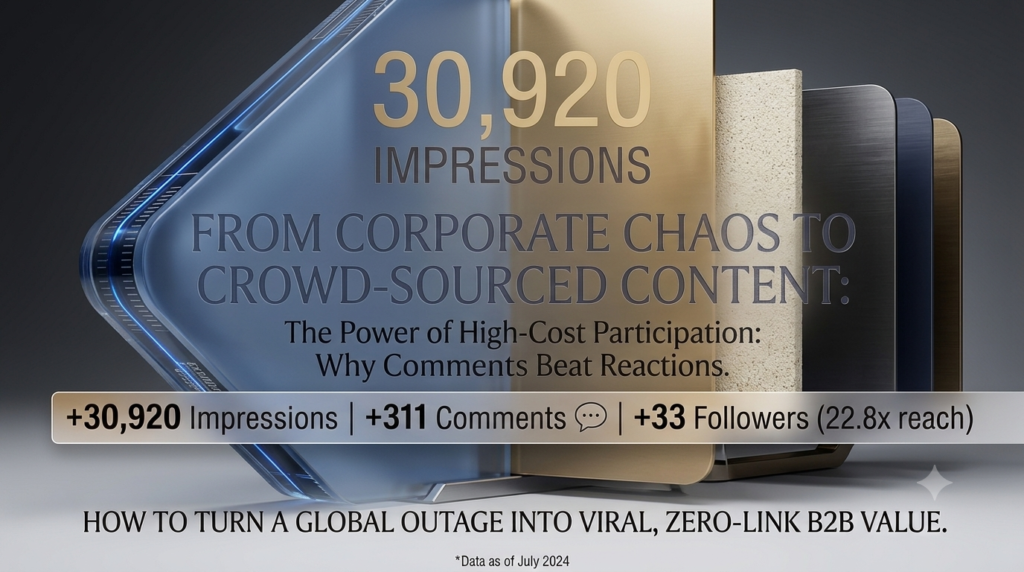
It pulled 30,920 impressions off a personal page with 1,356 followers — 22.8 times my own reach — and 311 comments against just 74 reactions.
That ratio is the entire story, and it’s worth actually unpacking, because most people look at the impressions number and miss it.
A like and a comment are not the same thing
Reacting to a post costs a reader nothing. One tap, no thought required. Commenting costs something — a few seconds spent actually coming up with a line worth posting.
On a normal post, reactions outnumber comments by a wide margin. That’s just how passive scrolling works. This post ran the opposite way, and not by accident. There was nothing to react to. The post didn’t work unless you answered it.
That distinction matters more than it sounds like it should, because LinkedIn’s own distribution rewards comments far more than it rewards reactions. Build a post where commenting is the only way to participate, and you’ve made the platform’s algorithm do your distribution for you.
Why this beat every well-written post I’ve ever put up
I’ve spent real time crafting posts that did a fraction of these numbers. The difference here wasn’t better writing. It was that this post asked for participation, not attention.
Attention is passive. Someone either notices you or they don’t. Participation is active — it asks someone to produce something, even something tiny, to be part of it. A one-line headline in the comments is a low bar. But it’s still a bar. And clearing a bar, however small, is what turns a scroller into a commenter.
The prize and the deadline weren’t just decoration either. ₹500 isn’t “get rich” money, but it’s enough to make the ask feel real. Midnight isn’t “sometime this week” — it’s a clock. Clocks make people write the line now, instead of bookmarking the post and forgetting about it.
The wrong lesson to take from this
Don’t read this as “run more giveaways” or “jump on every trending topic.” Neither is the point.
A prize-and-deadline challenge does one specific job: it converts people who are already paying attention to something — a news event, a shared moment — into people who briefly act inside your comment section. It’s not a funnel. It doesn’t explain a product or move anyone toward a purchase. It builds reach and a small spike in followers, because the format itself is worth engaging with, independent of who’s posting it or what they sell.
For a product marketer, that’s a distinct and useful tool — separate from, not a replacement for, content that actually moves someone through a buying decision.
What I’d change if I ran it again
Mostly the follow-through, not the format.
I had nothing ready to catch the 145 profile visitors or the 33 new followers this pulled in. No pinned post, nothing obvious for them to look at next. And I had no second post ready to test while that same wave of attention was still moving. A spike at over 20 times normal reach is the audience telling you, specifically, what they’ll respond to. The right move is to test that again immediately — not admire it a few weeks later, which is what I actually did.
The actual takeaway
Reach follows participation. It doesn’t work the other way around.
A post that requires the reader to produce something — even one line, even something as small as a headline — will consistently beat a post that only asks to be noticed, as long as the ask is small enough and the moment is real enough that people act on it now instead of later.
If you’re deciding whether a format like this is “too gimmicky” for a professional page, don’t look at the impressions count. Look at the comment-to-reaction ratio. If comments outnumber reactions, your audience didn’t just see the post. They did something with it.
You can find the original post here.
