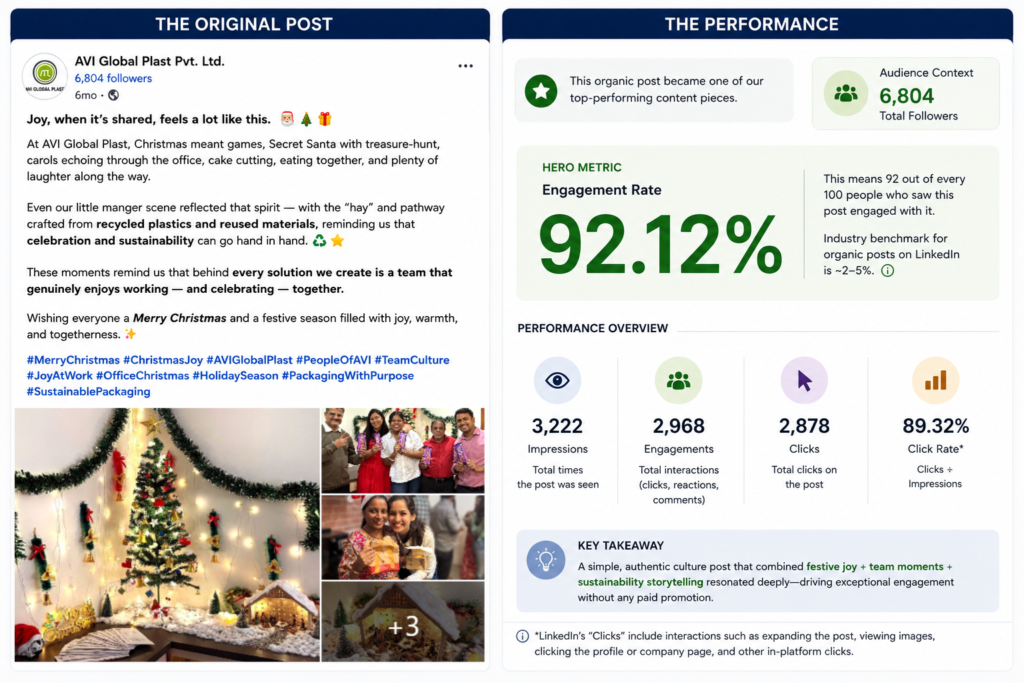
Last Christmas, we put up a post on AVI Global Plast’s LinkedIn page. No product shot. No feature list. No CTA.
Just photos from our office party — Secret Santa, cake cutting, a manger scene the team built out of recycled plastic and leftover packaging material. A short caption. A few hashtags.
It hit a 92.12% engagement rate.
For context: LinkedIn’s own benchmark for organic B2B posts sits somewhere around 2–5%. We were at 92%. Not a typo, not a boosted post, not a giveaway. Organic, unpromoted, on a page with 6,804 followers.
3,222 impressions. 2,968 engagements. 2,878 clicks. An 89.32% click-through rate on an organic post from a rigid packaging manufacturer.
I want to be honest about why, because “authenticity wins” is the kind of thing everyone says and almost nobody unpacks.
We didn’t set out to make a sustainability post
That’s the part I’d get wrong if I retold this too neatly. We didn’t sit down and plan “let’s demonstrate our values through employee storytelling.” Someone built a manger scene out of scrap plastic because that’s what was lying around the office. We photographed the party because it happened. The sustainability angle was already sitting inside the photo — we didn’t have to write it in.
That’s a different thing from a company deciding to run a sustainability campaign and then staging a photo to fit it. Audiences on LinkedIn are unusually good at telling the difference between a value that’s being demonstrated and one that’s being performed. This one wasn’t performed. It just happened to also be true.
Why this beat our product content, specifically
Our product posts — PET sheet specs, thermoforming line capabilities, certification announcements — do fine. They get seen by the people already looking for a packaging vendor. That’s a narrow audience by design, and it should be.
This post wasn’t talking to that audience. It was talking to anyone who’s ever worked in an office, celebrated with a team, or cared about where waste ends up. That’s a much bigger addressable audience, and it’s why the impression-to-engagement ratio looks the way it does — the content wasn’t asking for narrow relevance, it was asking for a much broader kind of recognition.
The mistake would be concluding “we should post more culture content instead of product content.” That’s not the takeaway. The takeaway is that they’re doing two different jobs. Product content moves someone through a buying decision. This kind of post builds the reputation someone is relying on before they ever start that buying decision — including with people who will never buy packaging from us but might refer someone who does, or apply for a job here, or mention us to a supplier.
What I’d actually change if I ran this again
Not the content — the follow-through.
We didn’t have anything ready to catch the attention once it arrived. No comment prompting a reply. No shorter opening line to hold people in the first two seconds. No version of this as a 20-second video, which almost certainly would have outperformed the static images given how the engagement curve looked.
The bigger miss: we didn’t have a second post ready to ride the same attention. When something organic performs at 20x benchmark, that’s a signal the audience is telling you something specific about what they want to see from the page. We let that signal sit unused for a few months instead of immediately testing a follow-up.
The actual lesson, stated plainly
An unmeasured win teaches you nothing. We only know this post did 92% because tracking was already in place — the same tracking discipline that’s behind everything else we’ve built on the marketing side this year. A number like 92.12% is only useful because we have a baseline to compare it against, and other posts to compare it to.
If you’re a B2B manufacturer wondering whether “soft” content like this is worth the slot on your content calendar next to your product posts — it is, but not because it’s more likeable. It’s worth it because it’s doing a job your product content structurally can’t: building the reputation that gets referenced long before anyone is in a buying cycle. Measure it the same way you measure everything else, and let the numbers tell you what to do next, rather than deciding in advance what kind of post you’re “supposed” to be.
You can find the original post here.