Positioning

Our Clever Startup Name Was Quietly Costing Us Customers When a name stops being an asset - Sampad

Our Clever Startup Name Was Quietly Costing Us Customers

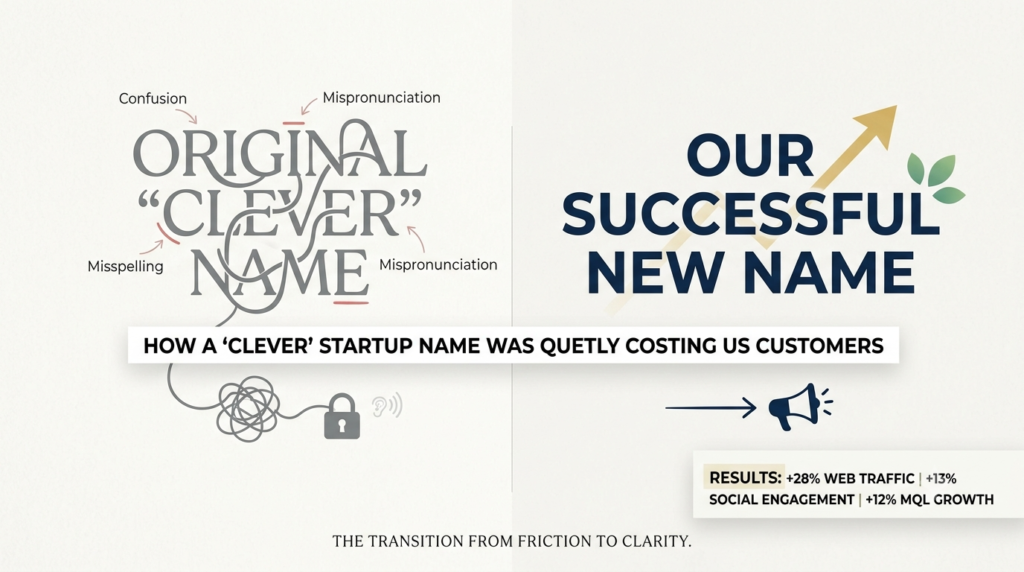
When a name stops being an asset At a retail-tech SaaS I worked at, the original product name sounded clever in the founders’ room. It had a story behind it, a bit of wordplay, the kind of name that gets nods of approval in an early pitch deck. It fell apart everywhere else. On sales calls, prospects would repeat it back to us, unsure if they’d got it right. At industry conferences, people misread it off our own booth signage. On support calls, customers would apologize before even attempting to say it out loud, then just spell it out letter by letter. It became something people joked about — and not the kind of joke that helps you close a deal or get remembered after a trade show. We didn’t rebrand because the name felt dated or because a founder got bored of it. We rebranded because the name had quietly become friction at every single touchpoint where a prospect or customer needed to trust us enough to say our name out loud, type it into a search bar, or recommend us to a colleague. The first signal: watch what breaks, not what feels off The instinct when a name isn’t landing is to treat it as a vague aesthetic problem — “it doesn’t feel right anymore.” That’s not a useful diagnosis. What we actually had was a pattern of very specific, very repeatable friction: mispronunciation on calls, misspelling in inbound emails, confusion at events, an awkward beat every time someone had to introduce us to someone else. None of that shows up in a brand survey asking “how do you feel about our name.” It shows up in call transcripts, support tickets, and the slightly embarrassed pause before a customer tries to say your name to their own boss. Once we started tracking it as an actual pattern rather than a vibe, it was obvious the name itself was a tax on every single go-to-market motion running through the business — sales, support, events, referrals, all of it. Don’t guess the fix. Ask the whole company The temptation at that point is to hand the problem to a naming agency and let them workshop something catchy. We did something slower and, in hindsight, far more useful first: we ran a company-wide roundtable. Not a marketing offsite — everyone who talked to a customer or prospect in any capacity was in the room. Sales, support, product, even people from finance who fielded vendor calls. The question was simple: what do we actually win on? Not what we say in our pitch deck — what genuinely gets a prospect to say yes, and what makes an existing customer stay. Finding the pattern underneath the noise Everyone answered differently at first. Sales talked about deal velocity. Support talked about how quickly issues got resolved. Product talked about how the platform pulled every sales channel into one place instead of forcing customers to stitch five tools together themselves. Different words, but two ideas kept resurfacing no matter who was speaking: speed, and unification. That wasn’t a coincidence — it was the company’s actual competitive advantage, sitting in plain sight, just never articulated as a single, shared answer before. Everyone had a piece of it. Nobody had said the whole thing out loud as one sentence. Building a name that carries the answer Once we had that — speed and unification as the two ideas that mattered most, backed by input from every team that touched a customer — the new name wasn’t a creative brainstorm exercise anymore. It was almost an engineering problem: build a name that encodes those two ideas clearly enough that someone hearing it for the first time could take a reasonable guess at what the product actually does. That’s a fundamentally different design brief than “pick something that sounds cool.” The old name had been chosen for cleverness. The new one was chosen because it did actual communication work — it told people something true about the product before they’d read a single word of copy. Treating the rename as a positioning decision, not a cosmetic one The rollout wasn’t just a new logo dropped onto the same website. We rebuilt the website, the brand identity, and the social presence from zero, all built around the same “fast, unified” idea the new name now carried. Every piece of the relaunch reinforced the same story the roundtable had surfaced, instead of just changing the wordmark and leaving everything else to catch up later. Results +28% website traffic, +13% social engagement, and +12% MQL growth in the period following the rebrand. The takeaway A name isn’t a decorative layer sitting on top of the real work of positioning — when it’s wrong, it’s active friction against every other GTM motion a company runs, and that friction is measurable if you look for it in the right places: call transcripts, event feedback, support tickets, not brand sentiment surveys. And when it’s time to fix it, the answer isn’t a naming consultant’s word list. It’s asking the people who talk to your customers every day what you actually win on, and having the discipline to build the name around their answer instead of your own cleverness.

Our Clever Startup Name Was Quietly Costing Us Customers Read More »

The Vertical That Was Killing Our Retention — And What Replaced It — Sampad

The Vertical That Was Killing Our Retention — And What Replaced It

The problem, in one number At a retail-tech SaaS I worked at, our largest customer segment by count was grocery — kirana stores. It was also the segment with the highest churn, the thinnest margins, and the most discount pressure at every renewal. On paper, it looked like a growth story. In the P&L, it looked like a slow leak. This isn’t a company-specific quirk — it’s structural to the category. Kirana stores make up the overwhelming majority of India’s grocery retail; by most estimates, roughly 12 million stores account for around 90% of grocery sales. But digitization inside that base has historically been shallow — of India’s 12+ million kirana stores, industry estimates put the number with actual app-based digitized operations at around 15,000, a rounding error against the total. The easy conclusion was that kirana simply couldn’t afford software. The real answer took longer to find, and it wasn’t really about money. Diagnosing it correctly The instinct when a segment churns hard is to fix retention — better onboarding, win-back campaigns, loyalty perks. We tried versions of that. It didn’t move the number, because retention tactics can’t fix a mismatch that isn’t really about retention at all. So instead of asking “how do we keep these customers,” we asked a different question: what were they actually trying to do with the product, and why weren’t they willing to pay for it? Going back through support tickets, sales call notes, and onboarding drop-off data, the pattern that emerged wasn’t budget. It was substitution. An app-based storefront put a kirana store in direct competition with Blinkit and Zepto — for exactly the customers most likely to abandon them anyway: younger, convenience-first, price-agnostic shoppers who’d order from whoever showed up fastest. Meanwhile, the customers a kirana store could actually retain — older, relationship-driven, the kind who visit as much to talk as to shop — never wanted an app in the first place. WhatsApp, or a conversation at the counter, did that job better than any storefront we could build. In other words, kirana’s low willingness to pay wasn’t a budget problem. It was that the product was quietly competing with the one relationship kirana owners could actually keep, while doing nothing for the one they’d already lost. What we did about the pricing, not just the roadmap Once that was clear, forcing a paid tier onto kirana stopped making sense — we weren’t going to price our way into a channel mismatch. Instead, we kept the segment on a freemium model: free for kirana, monetized elsewhere. The founder’s original mission — bringing a huge number of India’s retailers online, kirana included — never changed. What changed was the economics underneath it. The mission stayed intact. The monetization got smarter. The vertical we ruled out — and why Pharmacy retail looked tempting on paper: a large, fragmented, still-digitizing base. We ruled it out anyway. Pharmacy retail requires drug-license and regulatory compliance credentials we didn’t hold, and layering that compliance burden onto a horizontal commerce platform would have meant building — and certifying — an entirely different product, not extending the one we had. Chasing total addressable market without the right to actually operate in it isn’t expansion. It’s a distraction with a bigger number attached. Where we went instead, and why We expanded horizontally into fashion, white goods, D2C brands, and manufacturing — and the case for each held up in the market data, not just in inbound lead volume. Fashion was the clearest growth bet. India’s online fashion retail market was valued at roughly $21.6 billion in 2025 and is projected to reach around $98 billion by 2032. Fashion sellers also needed heavier catalog and variant management than grocery ever did, which played directly to strengths we’d already built. White goods and D2C brands offered something grocery couldn’t: basket size. Higher transaction values meant sellers in these categories could actually absorb a software subscription without it being a rounding error against their margin — the exact problem we’d had with kirana. Manufacturing and B2B rode a genuinely large structural tailwind, with India’s B2B online marketplace opportunity estimated to reach roughly $200 billion by 2030 — underserved infrastructure, not a crowded consumer category. Each pick answered the same question differently: does this vertical have the workflow we already support, and can the buyer actually pay for it without competing against a relationship they’re not willing to give up? Results 2,500+ new customers onboarded across the expanded verticals, 80+ product gaps resolved, DAU/MAU up 12%, support ticket volume down 40%. The takeaway The biggest shift wasn’t a rebrand or a new campaign. It was recognizing that a high-churn segment isn’t always a pricing failure — sometimes the product is quietly asking a customer to pay for something that competes with the one relationship they actually value. Once we saw that, the fix wasn’t a better retention campaign. It was matching the model to the segment: freemium where the product was substitutive, paid where it was additive — and picking the next markets based on where we could actually serve the buyer, not the biggest numbers on a slide. If you’re staring at a segment that won’t stop churning no matter what you throw at it, it’s worth asking the same question we did: is this a pricing problem, or is the product quietly competing with something the customer isn’t willing to give up?

The Vertical That Was Killing Our Retention — And What Replaced It Read More »