A different kind of starting problem
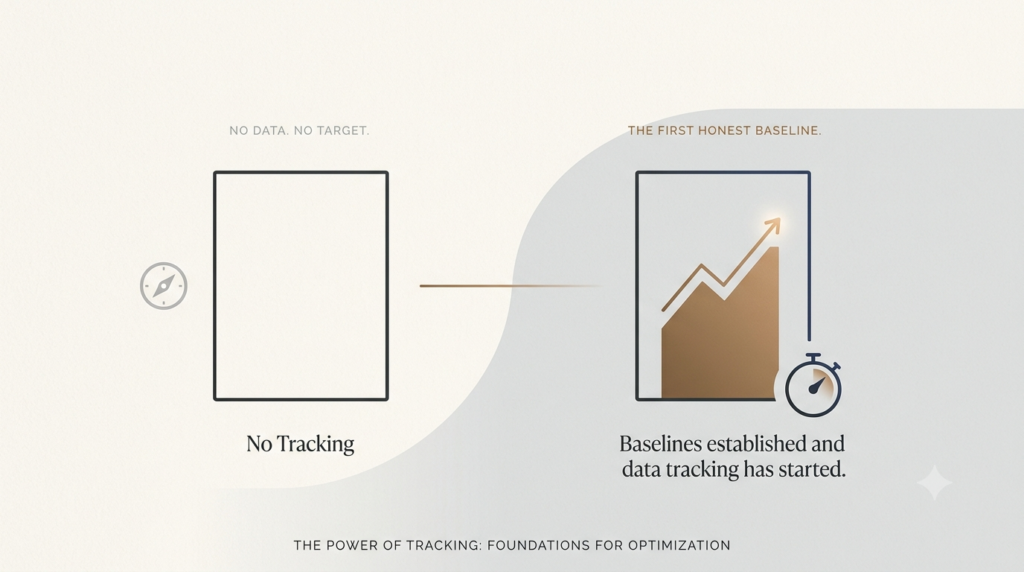
When I joined AVI Global Plast — a ₹300Cr export manufacturer operating across 33 countries and 6 continents — nobody was tracking anything. That’s worth sitting with for a second, because it’s a different problem than the one most marketers walk into. Bad numbers are fixable. A weak conversion rate, a mediocre engagement rate, a high bounce rate — all of that gives you something to work against. What we had instead was no data, no dashboards, and no one anywhere in the business responsible for what any channel was actually producing.
That’s not a strategy gap. It’s a measurement gap, and it sits underneath every strategy decision a marketing function tries to make. You can’t prioritize channels you’re not measuring. You can’t prove a campaign worked if you never had a number before it ran. You can’t even have a productive argument about what “good” looks like, because there’s nothing on the table to argue about.
Why no one owning tracking was the real problem
Every channel — the website, email, social, event lead capture — had been operating for years with no owner attached to its output. Not underperforming against a target. Simply unmeasured, which meant there was no target to underperform against in the first place. This is a subtler problem than it sounds, because a business can run for a long time this way without anyone noticing anything is wrong. AVI had a strong reputation and 25 years of export relationships built entirely without anyone tracking marketing performance — the absence of data doesn’t necessarily show up as an obvious crisis, it just quietly caps how much any future effort can be justified, prioritized, or improved.
Closing that gap had to come before any other marketing decision, because every other decision depends on it.
Tracking before optimizing, not the other way around
The instinct walking into a role like this is to start fixing things immediately — new website copy, a fresh campaign, a rebuilt email sequence. We deliberately didn’t start there. Before touching a single channel, we put tracking in place across all of them: website analytics, email open and click tracking, social performance measurement, and lead capture attribution from events.
The reasoning is simple but easy to skip under pressure to show quick wins: you cannot know whether a change worked if you never had a number before you made it. Optimizing without a baseline isn’t optimization — it’s just activity, with no way to tell afterward whether it helped, hurt, or did nothing at all.
Letting the first honest number set the baseline
Once tracking existed, the first numbers weren’t always flattering, and that’s exactly as it should be. An unflattering number you can act on is infinitely more useful than no number at all. The value of a baseline isn’t in how good it looks — it’s in the fact that it exists, and that everything measured afterward can be compared against it honestly.
Every optimization after that is the same mechanism, repeated
Once tracking was in place, every improvement that followed across every channel wasn’t really a series of separate clever tactics. It was the same underlying mechanism doing its job, over and over: show where the gap is, take an action, measure whether the action closed the gap. Website changes, email sequence adjustments, social content shifts — different tactics, same loop. The tracking is what turned isolated efforts into a system that compounds.
Why infrastructure comes after the discipline, not before it
Tools don’t create the habit of measuring — they scale it once it already exists. Building the tracking discipline first meant that whatever systems came next, whenever they arrived, would reinforce a way of working the team already trusted, rather than trying to manufacture that habit from scratch around a new piece of software. Sequencing it that way is what makes infrastructure investments actually stick instead of becoming another underused tool.
The takeaway
The biggest constraint on a marketing function isn’t usually a bad number. It’s the absence of any number to measure against, argue with, or improve. Once that gap closes — even with numbers that aren’t flattering at first — everything that follows becomes dramatically easier to prioritize, justify, and prove. That’s the real foundation any optimization work gets built on, and it has to come first, not as an afterthought once the “real” marketing work is already underway.
